Densmore sets the frame. Plant specimens were identified by Paul C. Standley of the United States National Museum, the pharmacology notes came from Dr. W. W. Stockberger, and the interpreter who made the whole thing possible was Mrs. Mary Warren English. Most of the people who described food preparation were women.
IDEAS TO LEARN
The varied uses of plants by the Chippewa indicate the large extent to which they understood and utilized the natural resources of their environment.
page 18The collection of the material herewith presented would have been impossible without the cooperation of members of the Chippewa tribe.
page 18
MACHINE-READ TEXT · 5 PARAGRAPHS
Uncorrected OCR from the Smithsonian scan. Spelling of Ojibwe words and botanical names may be garbled. The scan is the record.
02 · pages 19–20
Informants
The people who did the knowing, listed by community: White Earth, Ponsford, Mille Lac, Red Lake and the Manitou Rapids Reserve in Ontario. Each entry gives the everyday name, the Ojibwe name and its meaning. Nodinens is Little wind. Gagewin is Everlasting mist. Footnotes record who had died before the report went to press.
IDEAS TO LEARN
The purpose of this list is to identify the persons who chiefly contributed to the material herewith presented. The name given first is therefore the name by which the person is generally known.
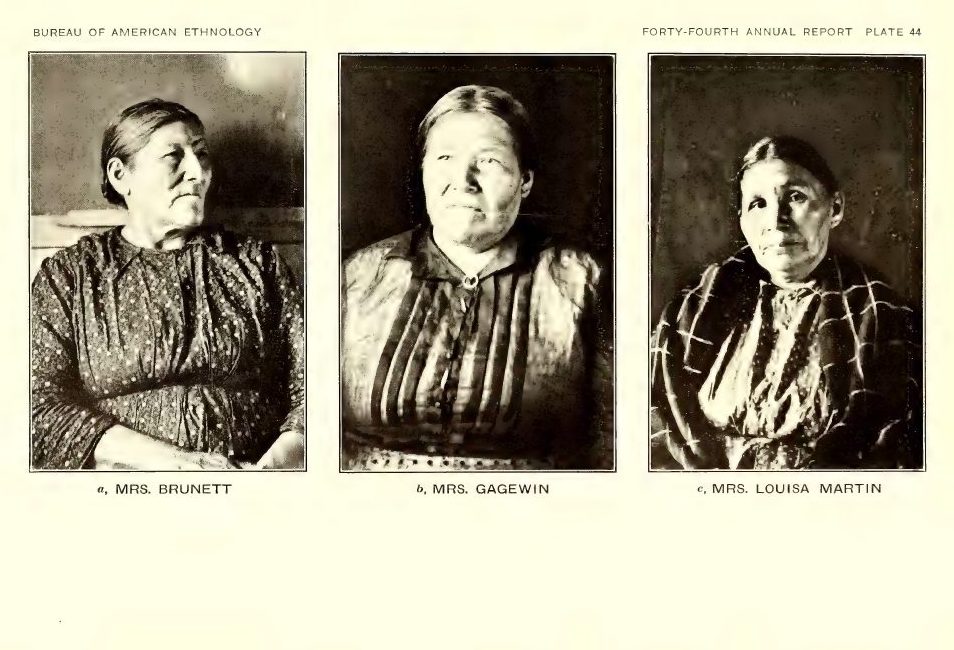
page 19Mrs. Gagewin. Nised’nagan’ob. Nised, corruption of the French Lizett, or Elizabeth; Naganob, name of her father, who was chief at Fond du Lac, Minn.
page 19
MACHINE-READ TEXT · 29 PARAGRAPHS
Uncorrected OCR from the Smithsonian scan. Spelling of Ojibwe words and botanical names may be garbled. The scan is the record.
One page on how the Ojibwe words in the report are spelled. The alphabet does not capture every sound. c stands for sh, j for zh, dj for the j in judge, and doubled dots mark vowels said separately.
IDEAS TO LEARN
The vowels and consonants employed in this work do not represent every sound that occurs in the Chippewa language.
page 21
MACHINE-READ TEXT · 4 PARAGRAPHS
Uncorrected OCR from the Smithsonian scan. Spelling of Ojibwe words and botanical names may be garbled. The scan is the record.
04 · page 24
Introduction
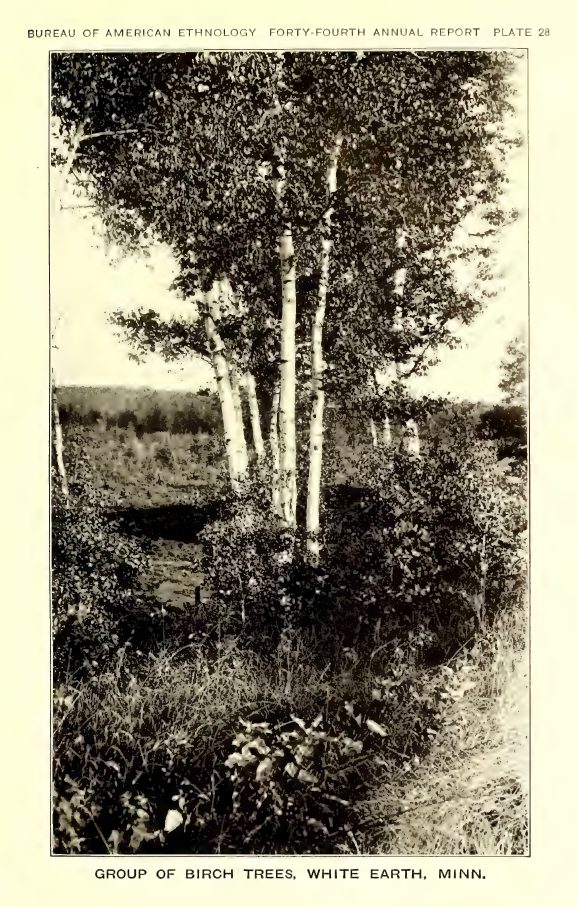
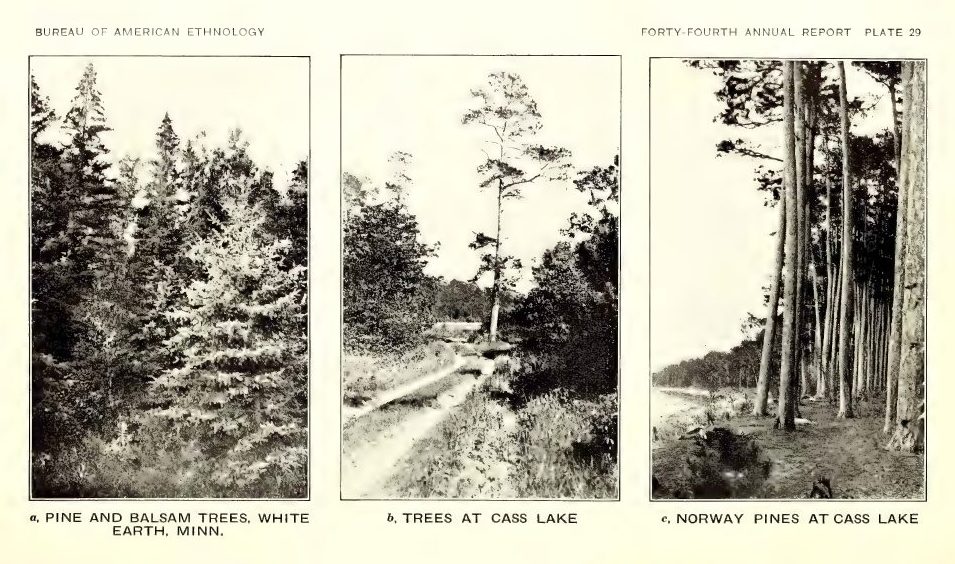
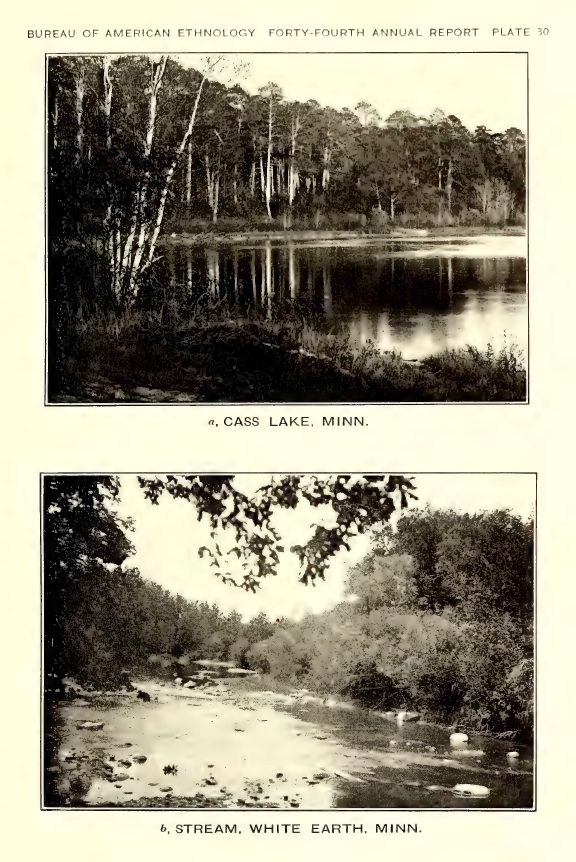
The country itself: birch groves on the hillsides, sugar maple tracts, forests of pine, cedar, balsam and spruce, lakes full of rice fields, pebbly streams. Densmore also explains why the same plant can have several names and uses depending on who is asked.
IDEAS TO LEARN
There are large tracts of sugar maples and forests of pine, cedar, balsam, and spruce. Many of the lakes contain rice fields, and there are pretty, pebbly streams winding their way among overhanging trees.
page 24
MACHINE-READ TEXT · 2 PARAGRAPHS
Uncorrected OCR from the Smithsonian scan. Spelling of Ojibwe words and botanical names may be garbled. The scan is the record.
05 · pages 25–37
Plants arranged by botanical, common and native name
Three cross-reference tables of the same plants. These pages are printed sideways in the scan, so the machine-read text is unusable. Read them in the PDF. The note on page 297 explains why a medicine man might teach a plant without ever naming it.
IDEAS TO LEARN
It was also customary for a medicine man, when teaching the use of a plant, to show a specimen of the plant without giving it any name. Thus the identity of the plant was transmitted with more secrecy than would have been possible if a name had been assigned to it.
page 36
These pages are tables printed sideways. Machine-read text is not usable here, so this chapter links straight to the scan.
06 · pages 38–41
Medicinal properties recognized by white medicine
Sixty-nine of the Chippewa plants also appeared in the United States Pharmacopoeia, the National Formulary or the dispensatories of the day. Each entry gives the botanical name, family and the action then attributed to it: balsam as stimulant and diuretic, bearberry leaves as antiseptic diuretic, wild cherry bark as sedative. A 1928 snapshot of one medicine looking at another.
IDEAS TO LEARN
The following 69 plants used by the Chippewa are regarded as medicinal by white people, although opinion as to their therapeutic value varies greatly.
page 38Ledum groenlandicum Oeder. Labrador tea. The leaves are expectorant and tonic. They are said to have been employed instead of tea leaves during the Revolutionary War.
page 40
MACHINE-READ TEXT · 72 PARAGRAPHS
Uncorrected OCR from the Smithsonian scan. Spelling of Ojibwe words and botanical names may be garbled. The scan is the record.
07 · pages 42–44
Principal active medicinal constituents
The chemistry, plant by plant, as it was understood in 1928. Balsam is a turpentine of 24 parts essential oil and 60 parts resin. Wintergreen carries methyl salicylate. Bloodroot holds the alkaloids chelerythrine and sanguinarine. Many entries simply read Undetermined, which is its own kind of honesty.
IDEAS TO LEARN
Abies balsamea. Constituents: A true turpentine consisting of 24 parts essential oil and 60 parts resin.
page 42Sanguinaria canadensis. Constituents: The alkaloid chelerythrine, sanguinarine, gamma-homochelidonine and protopine.
page 44
MACHINE-READ TEXT · 38 PARAGRAPHS
Uncorrected OCR from the Smithsonian scan. Spelling of Ojibwe words and botanical names may be garbled. The scan is the record.
08 · pages 45–46
Plants as food
A people subsisting chiefly on vegetable products and fish. Gardens were part of the working year and the harvest went into caches. Fish were dried or frozen, meat was pounded and mixed with tallow, rabbits were snared through winter, and every part of a bear was eaten or used.
IDEAS TO LEARN
Thus it is seen that the Chippewa were a people subsisting chiefly on vegetable products and fish, though they secured deer and other animals by hunting.
page 45The bear was an especially useful animal, as all parts of it were either eaten or utilized.
page 45
MACHINE-READ TEXT · 8 PARAGRAPHS
Uncorrected OCR from the Smithsonian scan. Spelling of Ojibwe words and botanical names may be garbled. The scan is the record.
09 · pages 47–55
Making maple sugar
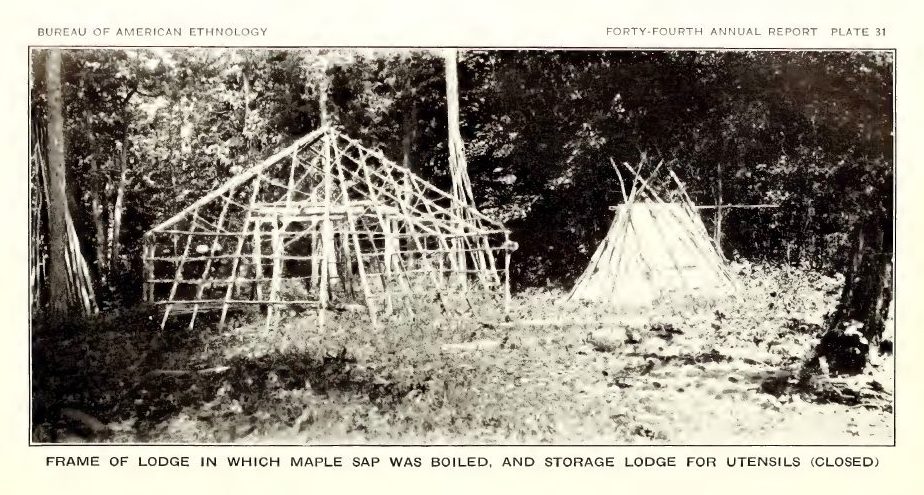
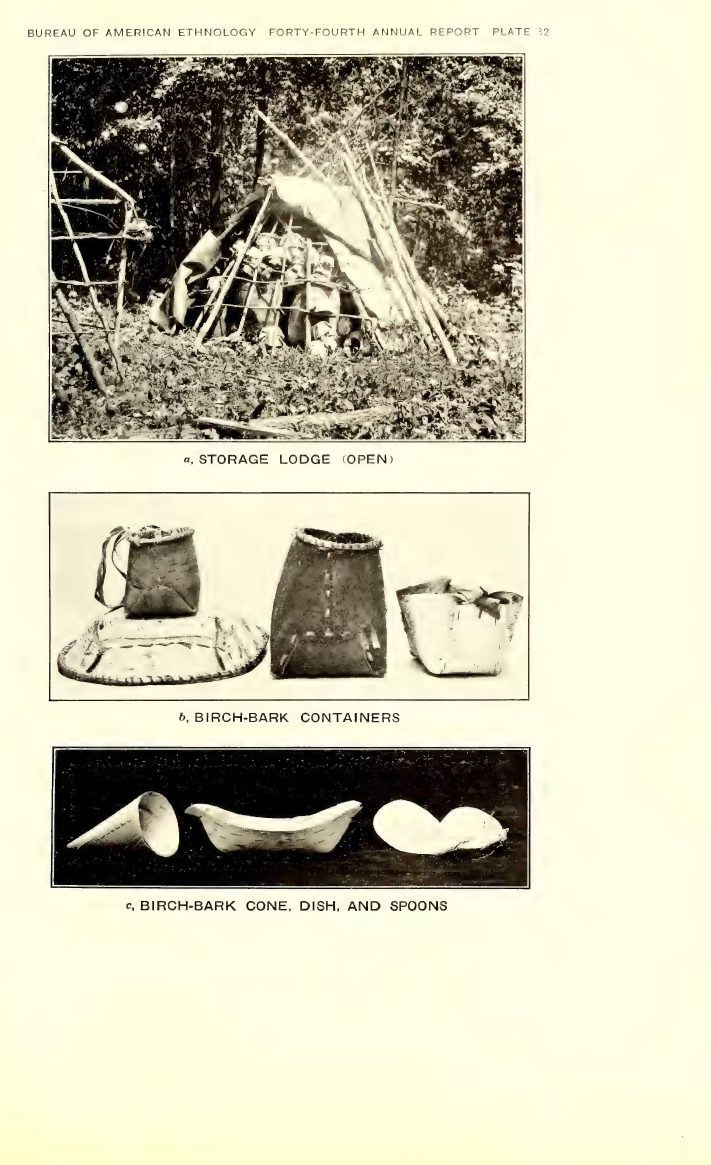
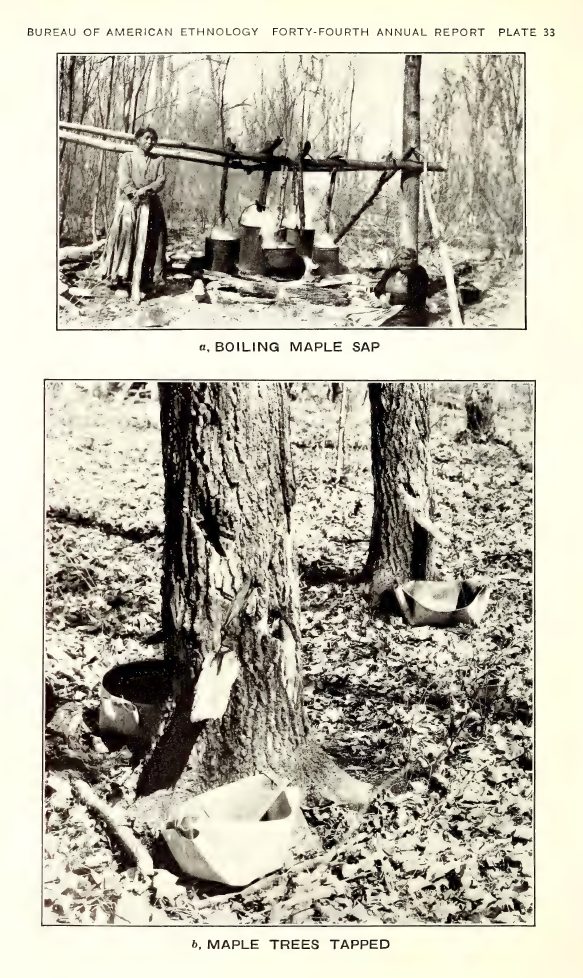
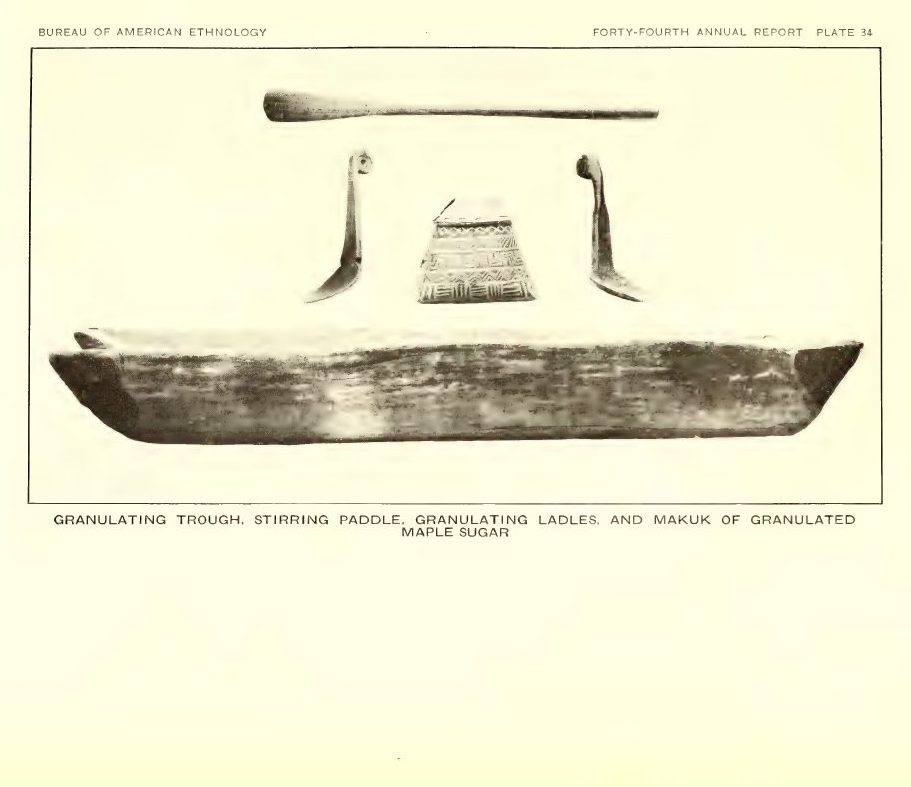
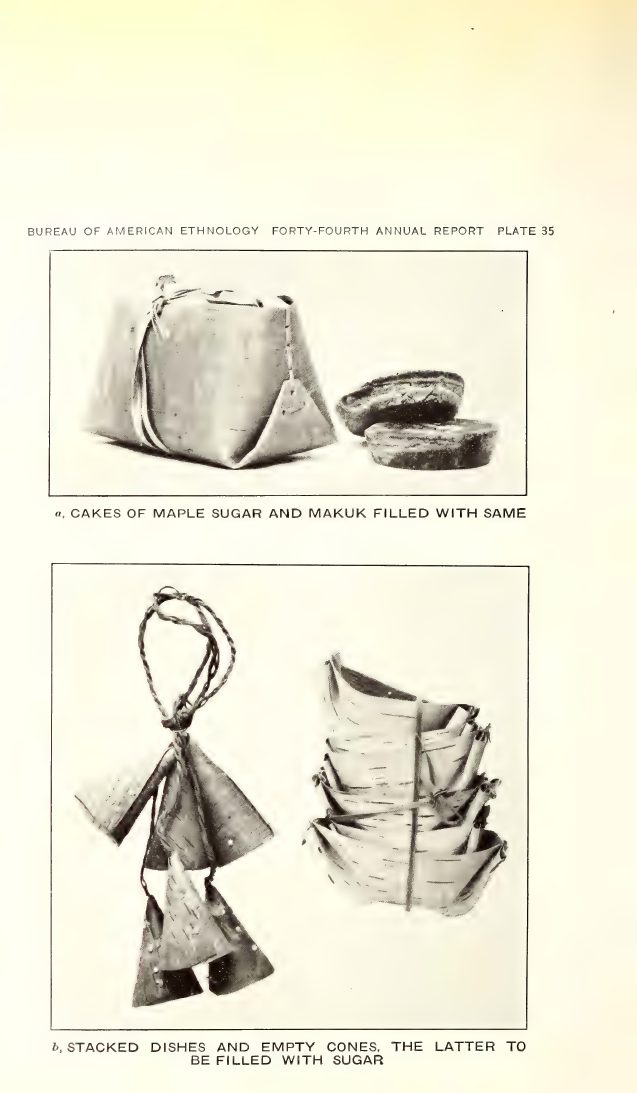
Maple sugar and wild rice were the two most important vegetable foods. Each family had its own sugar bush, sized not by trees but by taps, nine hundred being average. The season opened in mid March and ran about a month. Sap boiled all night, a spruce branch calmed a kettle that boiled too fast, deer tallow kept the sugar soft when it grained. Sugar was stored in birch-bark makuks and cones and used as seasoning on everything, long before salt.
IDEAS TO LEARN
The two most important vegetable foods were maple sugar and wild rice. The obtaining of these commodities was attended with much pleasure, though the temporary camps were busy and there was work for young and old.
page 47The capacity or size of a sugar bush was not estimated by the number of maple trees but by the number of ‘taps,’ as it was not unusual to make two or three taps in a large tree. Nine hundred taps was an average size.
page 52If a kettle boiled too rapidly a branch of spruce attached to a stick was dipped into the froth. The motion was little more than a brushing of the froth with the spruce, but the bubbling at once subsided.
page 54When it became thick, small pieces of deer tallow were put in it. This was said to make the sugar soft and not brittle.
page 55
MACHINE-READ TEXT · 43 PARAGRAPHS
Uncorrected OCR from the Smithsonian scan. Spelling of Ojibwe words and botanical names may be garbled. The scan is the record.
10 · pages 56–69
Gathering wild rice
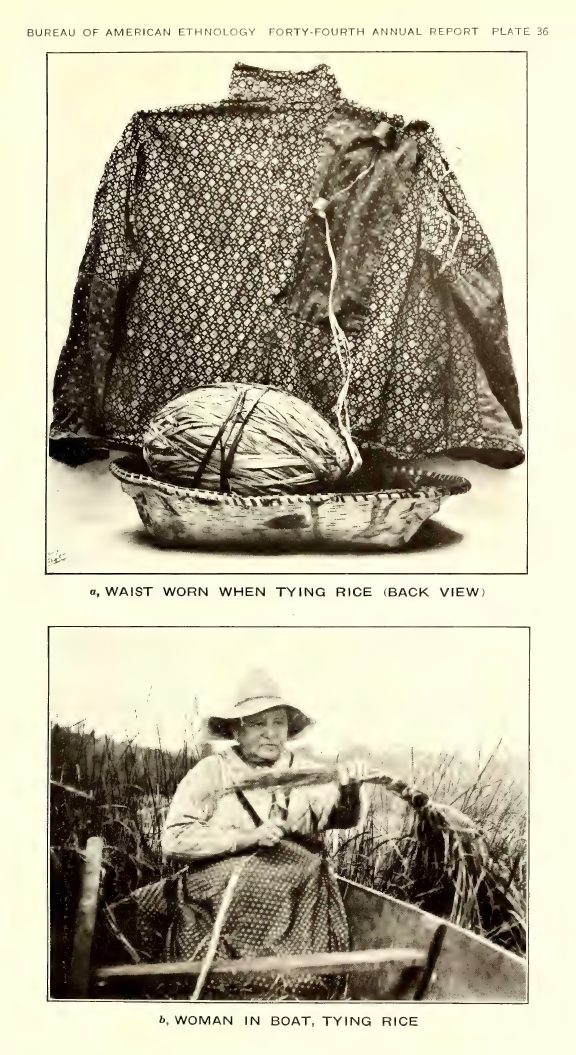
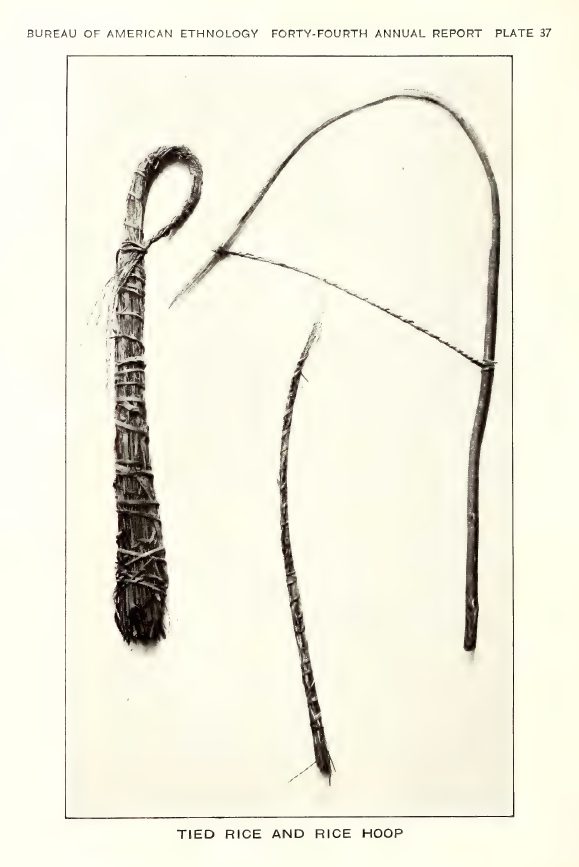
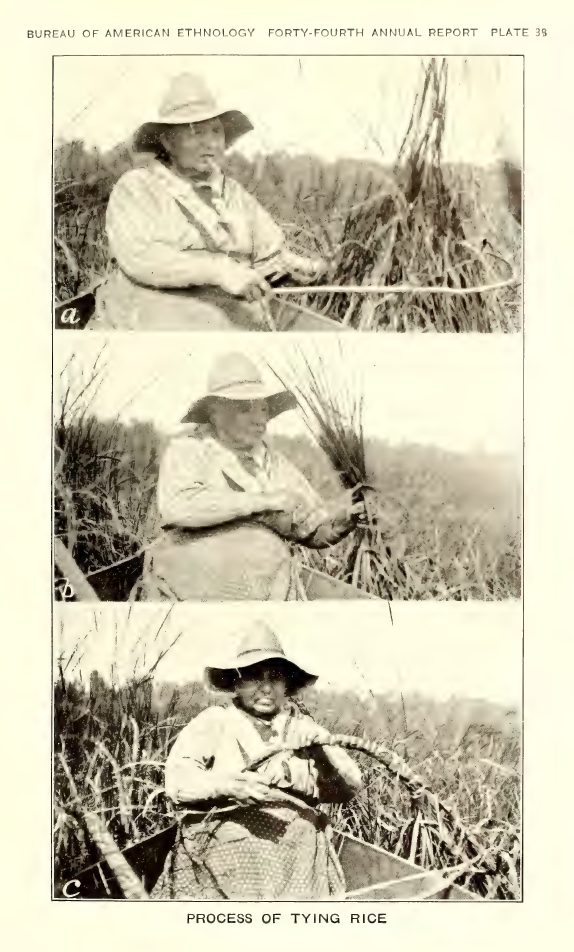
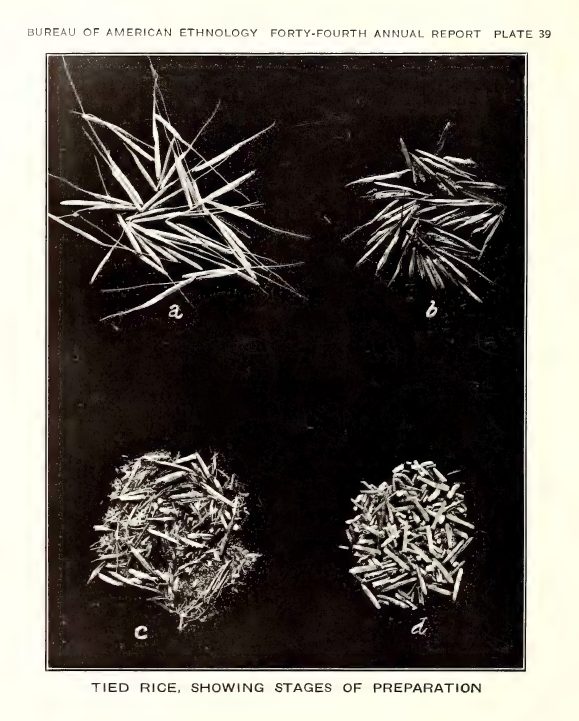
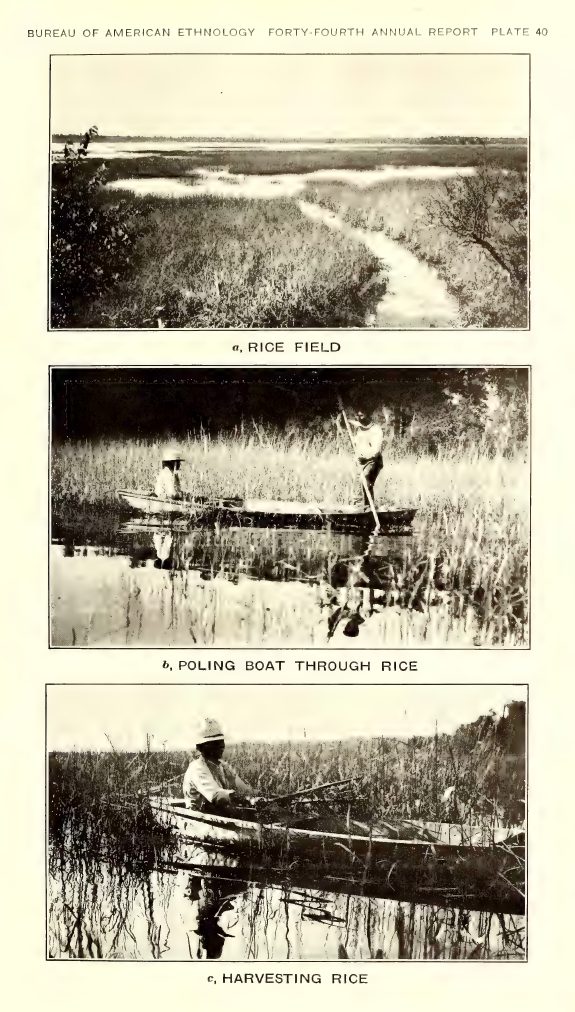
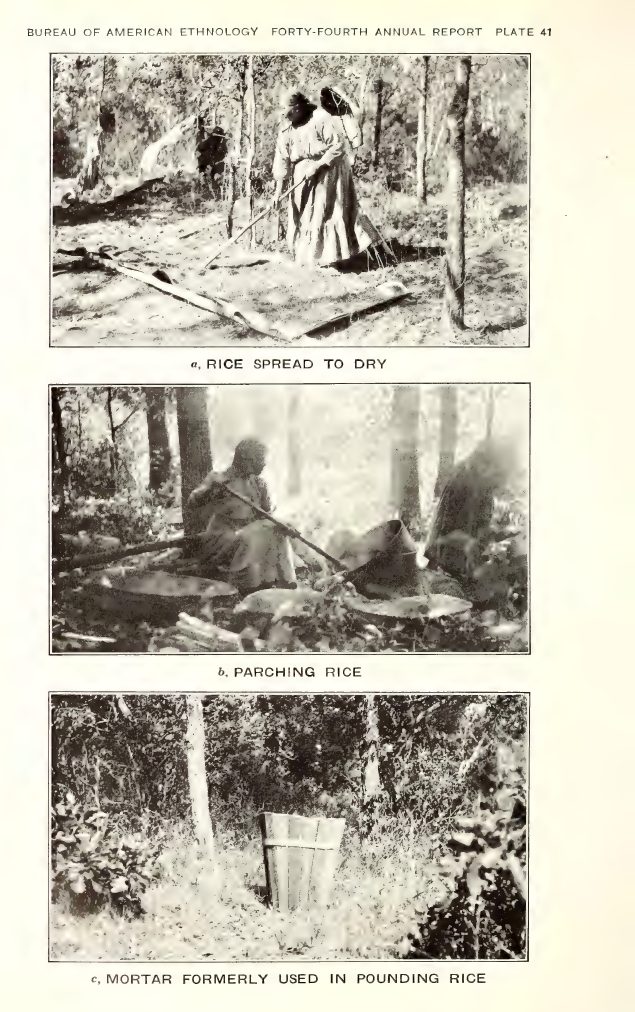
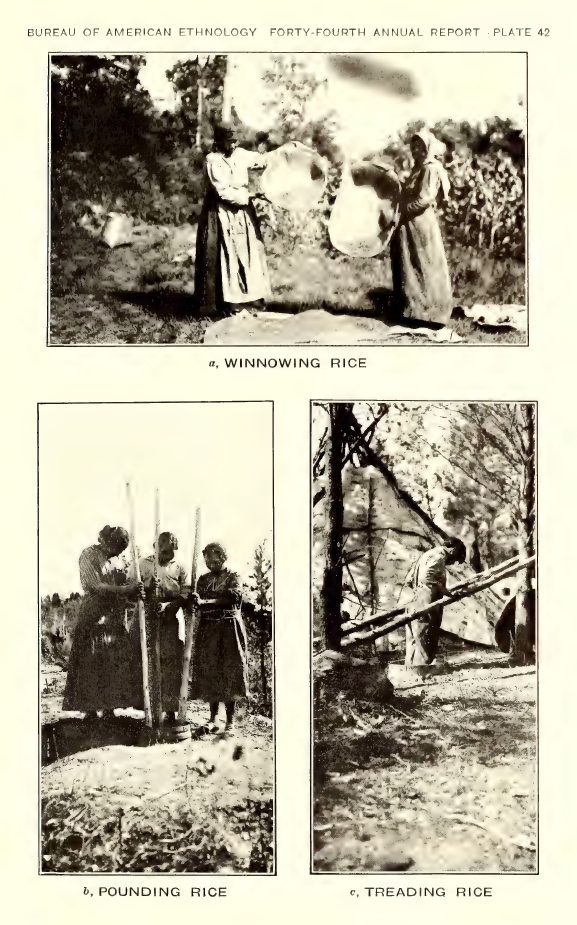
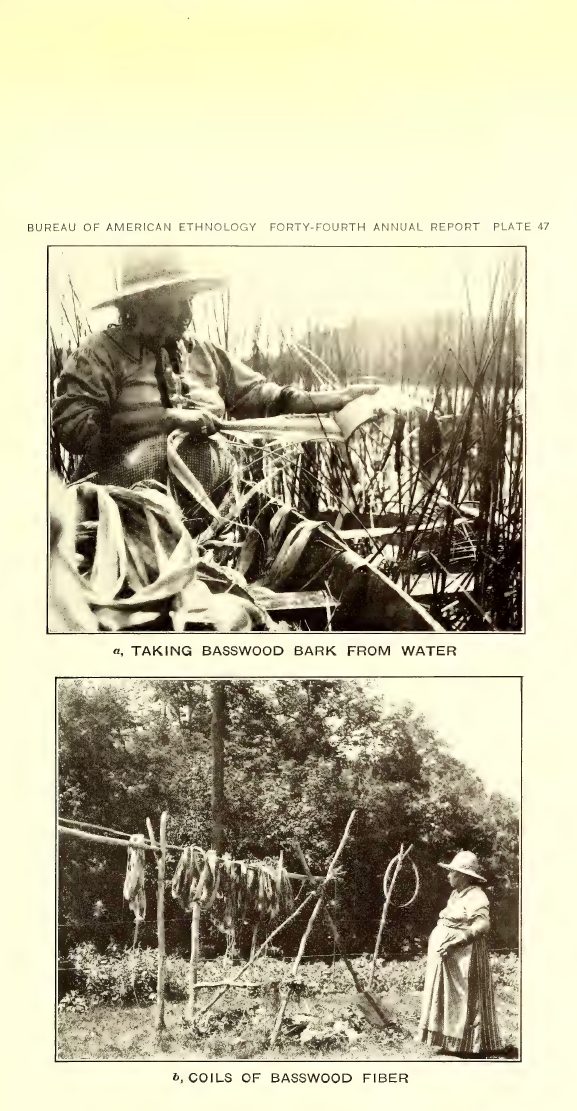
Each family held a portion of a rice field the way it held a sugar bush. About ten days before the rice ripened a woman claimed her portion by tying the standing stalks into sheaves with untwisted basswood fiber. At harvest a man poled the canoe while a woman knocked the kernels in. Then the rice was dried, parched, pounded, winnowed and trodden in clean moccasins.
IDEAS TO LEARN
The portion of a rice field was outlined by stakes, and a woman established her claim to it by going to the field about 10 days before the rice was ripe and tying portions of it in small sheaves.
page 56A canoeful of rice was considered a day’s gathering.
page 57It was considered a test of a good rice gatherer to free the ripe rice kernels without dislodging those which were unripe. Thus it was possible to go over the same part of a rice field several times at intervals of a few days.
page 57The treading was done by a man wearing clean moccasins, and the poles were for him to rest his arms upon during the process.
page 69
MACHINE-READ TEXT · 21 PARAGRAPHS
Uncorrected OCR from the Smithsonian scan. Spelling of Ojibwe words and botanical names may be garbled. The scan is the record.
11 · pages 70–71
Beverages, seasonings and cereals
The Chippewa did not commonly drink water met on the trail. They boiled it and made a drink of it: Labrador tea, wintergreen, cherry twigs, raspberry twigs. One man described a woman who dried more than twenty kinds of flowers by the first of July for a winter drink. Maple sugar was the seasoning for everything. Salt arrived by treaty in 1847 and some elders never took to it.
IDEAS TO LEARN
It is interesting to note that the Chippewa did not commonly drink water encountered in traveling but boiled it, making some of the following beverages.
page 70He said that by the first of July she had more than twenty varieties. In the fall she pulverized them and stored them.
page 70In the early days the Minnesota Chippewa had no salt and some of the older Indians have not yet acquired a taste for it.
page 71
MACHINE-READ TEXT · 28 PARAGRAPHS
Uncorrected OCR from the Smithsonian scan. Spelling of Ojibwe words and botanical names may be garbled. The scan is the record.
12 · pages 72–74
Vegetables and berries
Corn parched, pounded to meal and made into soup with deer tallow, or turned to hominy with hardwood-ash lye. Pumpkins and squash cut into rings and dried. Wild potatoes, arrowhead, marsh marigold, milkweed flowers, cattail root. Then the berries: blueberries dried in the sun, chokecherries pounded stones and all, cranberries, grapes, and Juneberries, the simplest form of refreshment.
IDEAS TO LEARN
These are called ‘Juneberries’ by the Chippewa and are found abundantly in their country. They are considered the simplest form of refreshment. ‘Take some Juneberries with you,’ is a common saying among the Chippewa.
page 74All dried berries were boiled when used, and either seasoned with maple sugar or combined with other foods.
page 75
MACHINE-READ TEXT · 33 PARAGRAPHS
Uncorrected OCR from the Smithsonian scan. Spelling of Ojibwe words and botanical names may be garbled. The scan is the record.
13 · pages 75–77
Plants as medicine: treatment
How a remedy came to be known and kept. The Midewiwin taught that every tree, bush and plant has a use. Remedies were individual property, not general knowledge. Members follow the bear path from one degree to the next and some of the best remedies were said to come from the bear. Dreams, purchase and inheritance were the other routes.
IDEAS TO LEARN
It is a teaching of the Midewiwin that every tree, bush, and plant has a use.
page 75The remedies are individual, not general, and an individual when questioned invariably replies, ‘I can tell you about my own medicines. I do not know about other peoples’ medicines nor their uses of the same plants.’
page 76It is said that members of the Midewiwin ‘follow the bear path’ in proceeding from a lower to a higher degree in the society and that some of the best Mide remedies were received from the bear.
page 76
MACHINE-READ TEXT · 25 PARAGRAPHS
Uncorrected OCR from the Smithsonian scan. Spelling of Ojibwe words and botanical names may be garbled. The scan is the record.
14 · pages 80–84
Gathering and preparing remedies
Tobacco went into the ground beside the plant before it was dug, and the digger spoke to it. Roots were gathered before the sap rose or after it fell, bark when the sap was up. Some roots had a strongest part, the elbow of dogbane. Names came from place, appearance, taste or the part used. Combinations ran to twenty herbs. Doses were a large swallow, and one careful practitioner’s pail held about a pint.
IDEAS TO LEARN
You were allowed to grow here for the benefit of mankind, and I give you this tobacco to remind you of this, so that you will do the best you can for me.
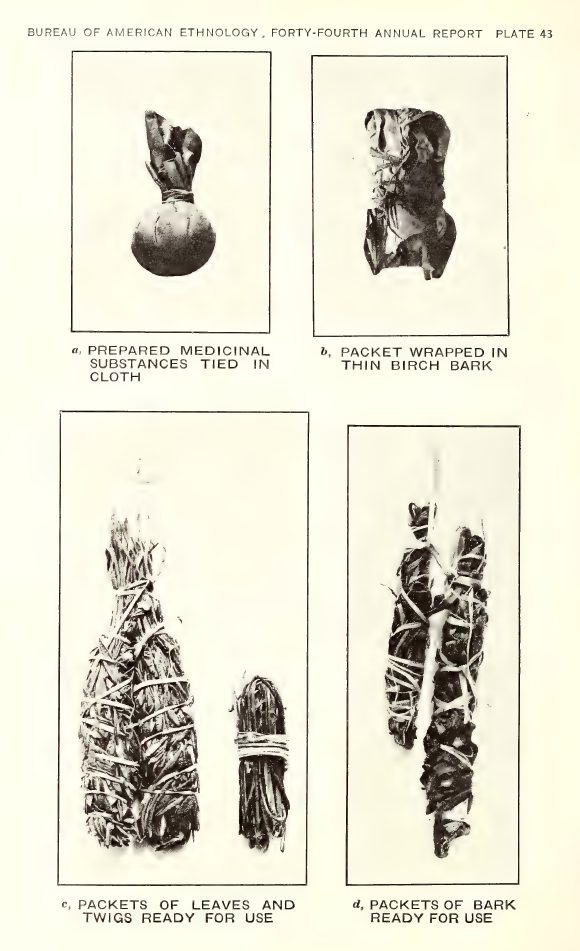
page 80Bark was gathered when the sap was in the tree but roots intended for future medicinal use were gathered before the sap started in the spring or after it had gone down in the fall.
page 81Thus in dogbane the part preferred was the elbow of the root, the plant having a root which descends straight downward for 15 to 18 inches and then turns sharply to one side.
page 81The Chippewa use combinations of herbs, sometimes as many as 20 vegetable substances being combined in one remedy.
page 84Liquid medicine was not measured when taken. A ‘large swallow’ constituted an average dose.
page 84
MACHINE-READ TEXT · 27 PARAGRAPHS
Uncorrected OCR from the Smithsonian scan. Spelling of Ojibwe words and botanical names may be garbled. The scan is the record.
15 · pages 85–90
Administration, appliances and surgery
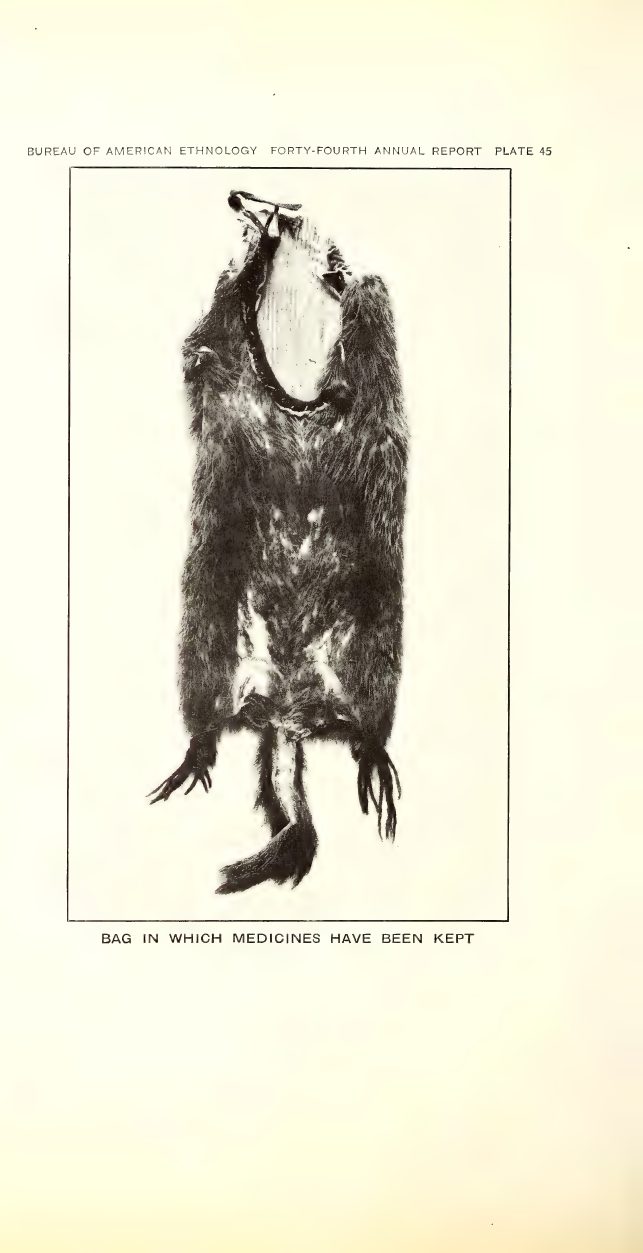
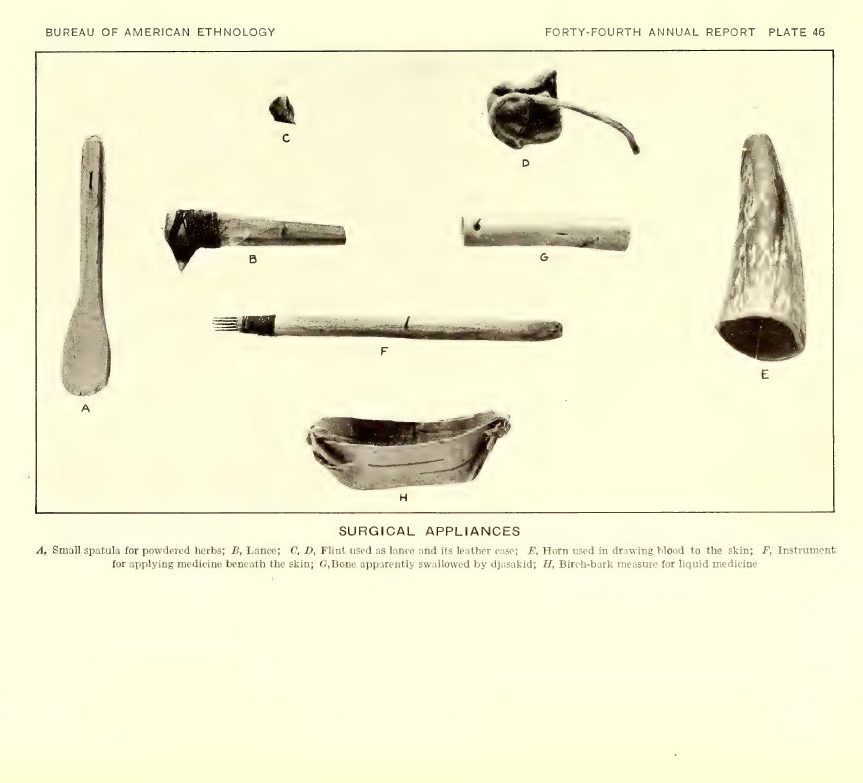
Seven ways to give a remedy externally and seven internally, from poultice and steam to pipe and enema. Non-plant remedies: deer tallow, bear grease, clamshell for mixing. Appliances: the sweat lodge, steam over hot stones for headache, a strip of slippery elm bark in place of an emetic, a deer bladder as syringe. Surgery: bloodletting, gashes made with flint or glass, cupping with a horn, a needle instrument, and Main’gans’ own account of the knife that amputated his frozen limbs when he was a boy.
IDEAS TO LEARN
Remedies were administered externally in the following manner: (1) Fresh roots or leaves were macerated and applied. (2) Dried roots or leaves were pulverized, prepared in the form of a decoction, and applied.
page 85The patient covered his head and shoulders with a blanket, inclosing the stones and inhaling the fumes. A mixture of many varieties of flowers was said to be an agreeable preparation for this use.
page 86The writer saw a woman whose elbow had been cut with 15 or 20 gashes about a quarter of an inch long. This treatment was given for a sprain, her elbow having swollen to twice its natural size.
page 87
MACHINE-READ TEXT · 36 PARAGRAPHS
Uncorrected OCR from the Smithsonian scan. Spelling of Ojibwe words and botanical names may be garbled. The scan is the record.
16 · pages 91–125
Medicinal plants, the tabulated list
Thirty-five pages of tables: ailment, plant, part used, preparation, dose, and the informant’s own words. This is the table the field list on the home page is built from. The pages are printed sideways in the scan, so read them in the PDF or use the field list.
IDEAS TO LEARN
This root grows straight downward and then turns sharply. The strongest medicinal value is at the elbow where the root turns.
page 94
These pages are tables printed sideways. Machine-read text is not usable here, so this chapter links straight to the scan.
A vegetable substance for the color and a mineral one to set it. Porcupine quills took dye best and held it longest, rushes worst. Butternut inner bark gave black. Red-osier dogwood inner bark with birch bark and cedar ash gave red. Recipes are given with the informant’s quantities.
IDEAS TO LEARN
The general process of dyeing among the Chippewa consisted in the use of a vegetable substance to secure a color and of a mineral substance to ‘set’ it.
page 126Porcupine quills were the articles most easily dyed, and they retain their color longest. Rushes are the hardest material to dye.
page 126
MACHINE-READ TEXT · 73 PARAGRAPHS
Uncorrected OCR from the Smithsonian scan. Spelling of Ojibwe words and botanical names may be garbled. The scan is the record.
18 · pages 132–133
Charms
Herbs believed to act by their presence, without contact. To be effective they had to be talked and prayed over when gathered and when used. Densmore sorts them into classes: love, worldly goods, safety, animals, evil, and protection against it. The same plant could be a charm and a medicine: dogbane, wild pea, Seneca snakeroot.
IDEAS TO LEARN
In order to make these substances effective it was considered necessary to ‘talk and pray’ over them when they were used, and, in the case of an herb, to ‘talk and pray’ when it was gathered.
page 132In addition to the vegetable substances believed to have an effect when administered internally or externally there were herbs and roots believed to act by their presence independent of actual contact.
page 82
MACHINE-READ TEXT · 24 PARAGRAPHS
Uncorrected OCR from the Smithsonian scan. Spelling of Ojibwe words and botanical names may be garbled. The scan is the record.
19 · pages 134–137
Useful and decorative arts
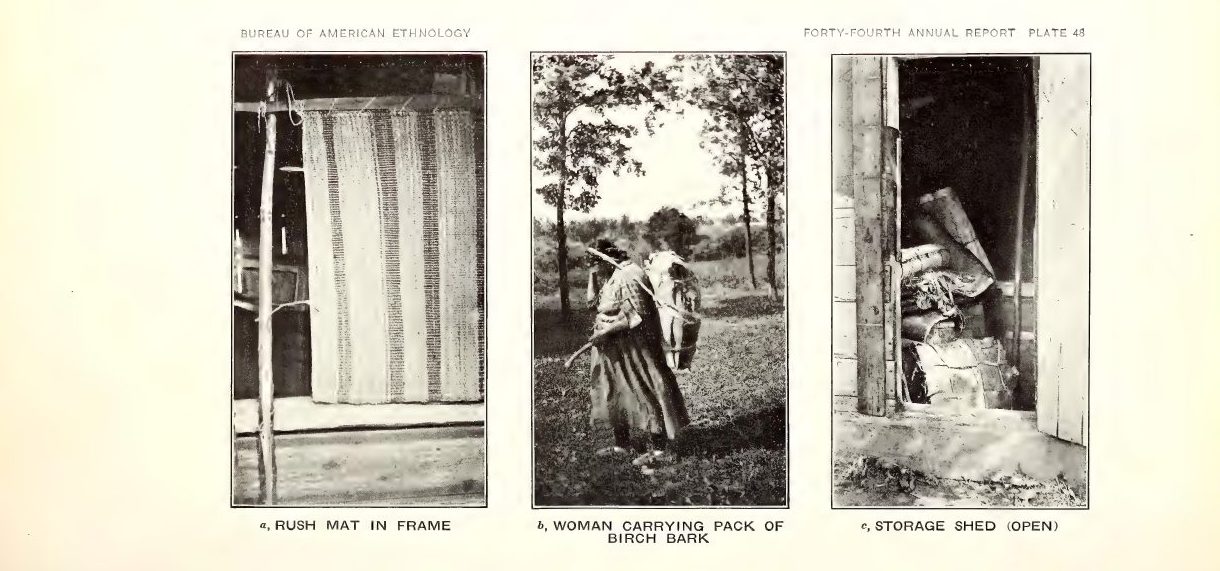
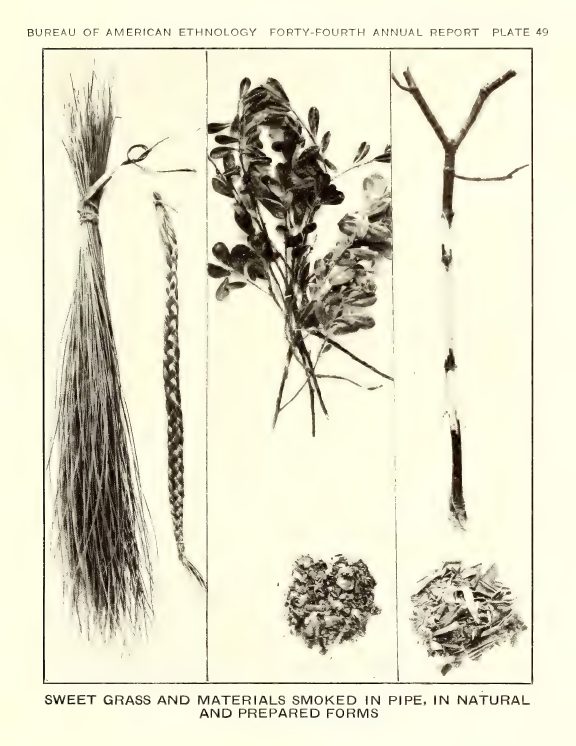
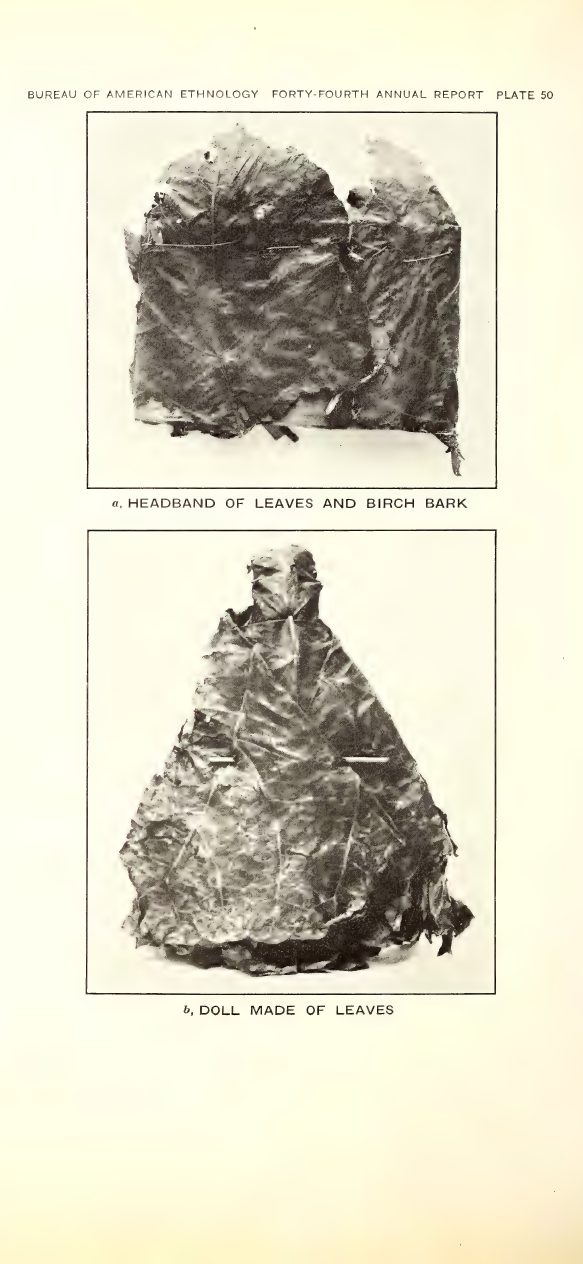
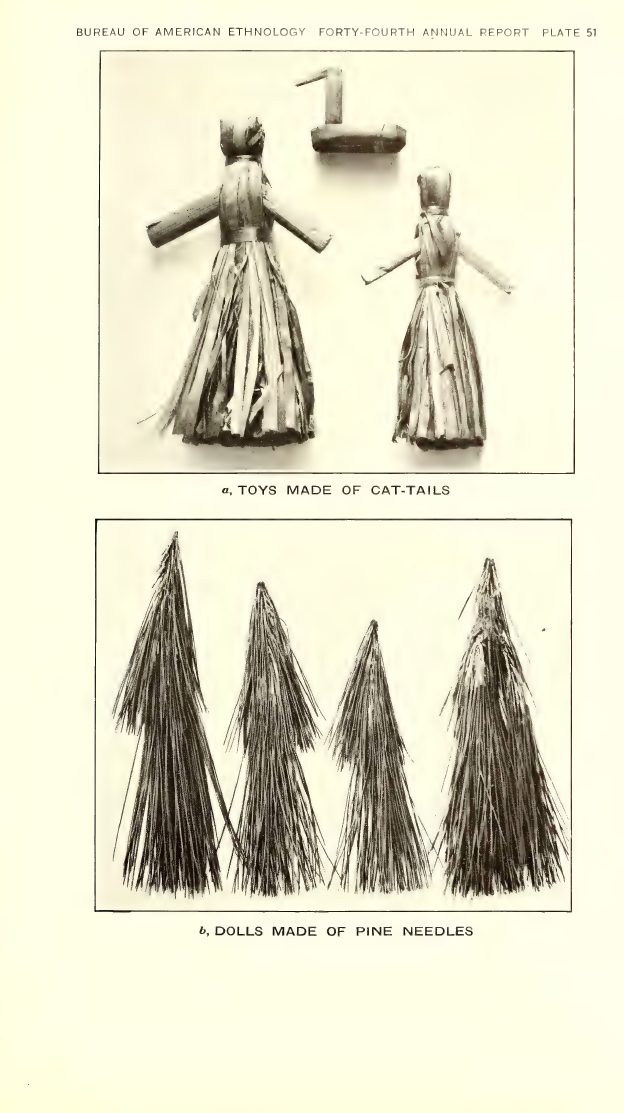
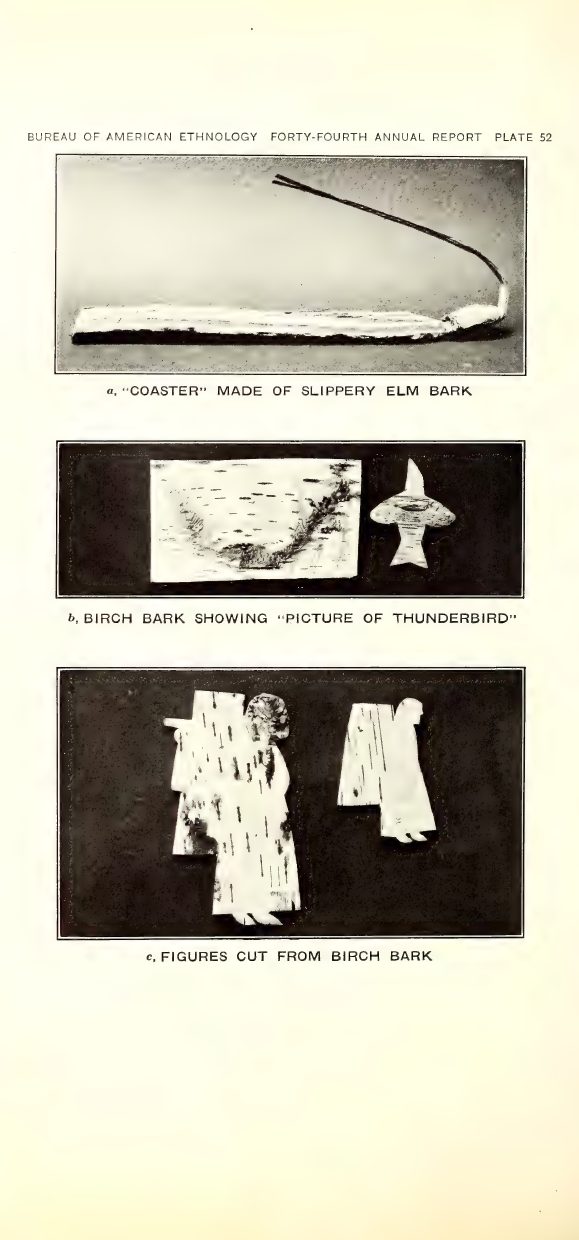
Twine from basswood inner bark was one of the most important articles in Chippewa economic life. Bulrush mats woven on frames, reed racks for drying berries, thorn-apple awls, spruce gum for caulking, tamarack root for sewing canoes, cedar boughs for bedding. Toys: onion-stem whistles, elm-bark dolls, cattail ducks blown across still water, pine-needle figures, a slippery-elm coaster. Sweet grass was ceremonial, economic and simply pleasant.
IDEAS TO LEARN
Twine was one of the most important articles in the economic life of the Chippewa. It was made chiefly from the inner bark (fiber) of the basswood.
page 135The children themselves cut the stems of the wild onion and made little whistles.
page 136Three types of uses of sweet grass were noted among the Chippewa, i. e., ceremonial, economic, and pleasurable.
page 137
MACHINE-READ TEXT · 44 PARAGRAPHS
Uncorrected OCR from the Smithsonian scan. Spelling of Ojibwe words and botanical names may be garbled. The scan is the record.
20 · pages 144–149
The sacred trees and the Winabojo legends
Birch and cedar were held sacred for two joined reasons: their great usefulness and their connection with Winabojo. Mrs. Razer told the legends. Winabojo and the birch tree begins with an old woman and a foundling girl on the shore of Lake Superior and ends with Winabojo sheltering from the thunderbirds inside a hollow birch, which is why the tree protects and preserves. The cedar story follows Grand Medicine men to the spirit land and back.
IDEAS TO LEARN
The birch and the cedar were regarded as ‘sacred’ by the Chippewa. The two reasons for this ‘sacredness’ are closely connected. One is the great usefulness of these trees to the Chippewa and the other is their connection with Winabojo.
page 144There was once an old woman living all alone on the shore of Lake Superior. She had a little girl living with her whom she called her daughter, though she did not know exactly where the child came from.
page 144As long as the world stands this tree will be a protection and benefit to the human race. If they want to preserve anything they must wrap it in birch bark and it will not decay.
page 147
MACHINE-READ TEXT · 50 PARAGRAPHS
Uncorrected OCR from the Smithsonian scan. Spelling of Ojibwe words and botanical names may be garbled. The scan is the record.
21 · pages 149–153
Gathering bark and the articles made from it
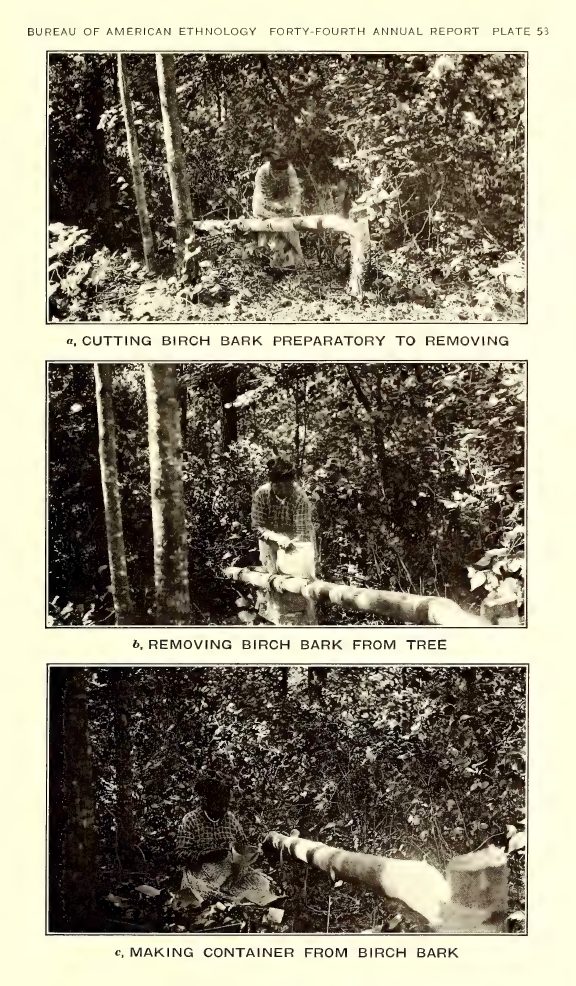
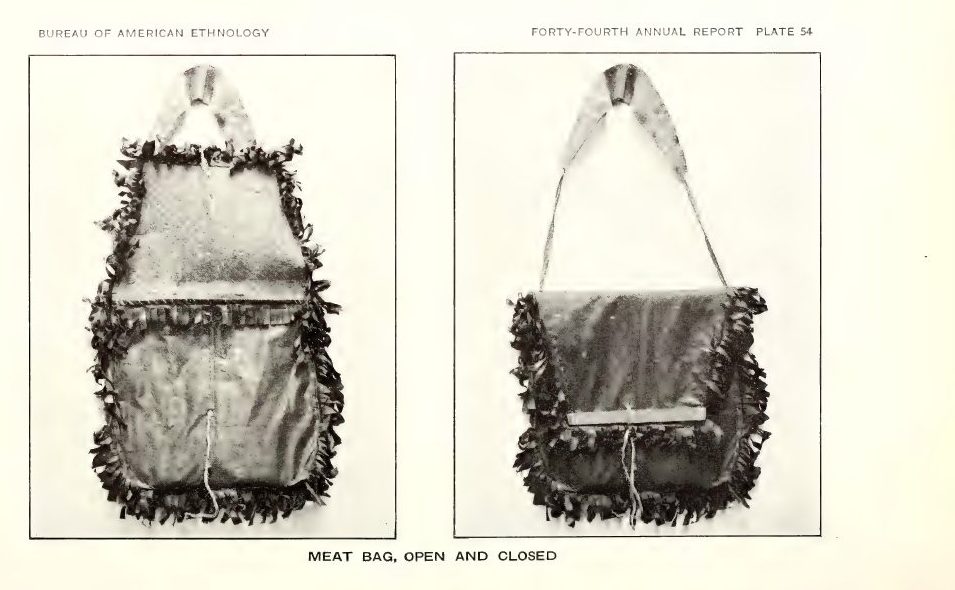
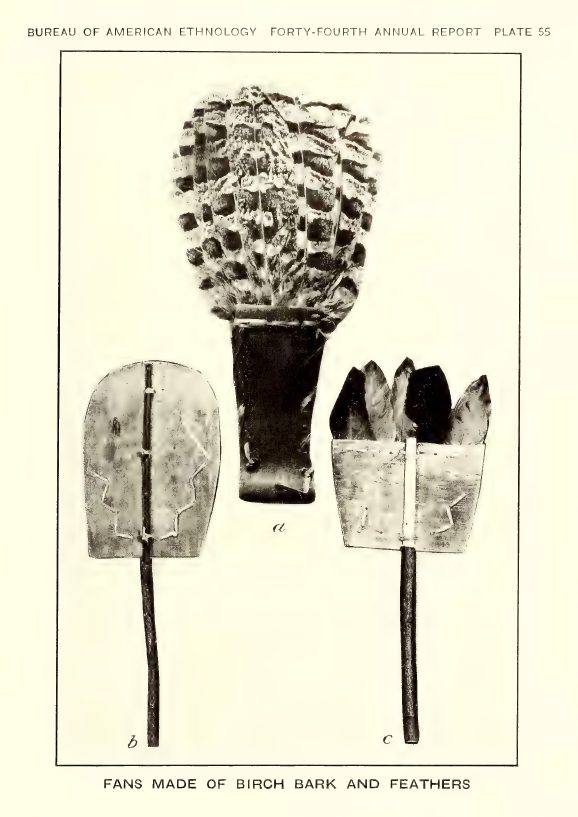
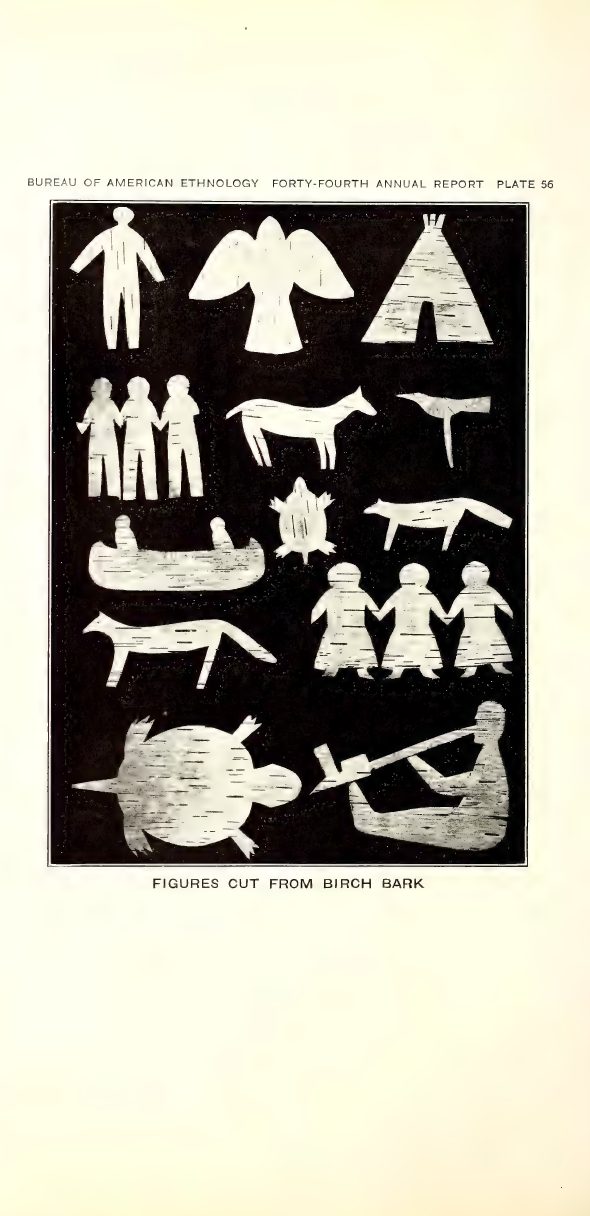
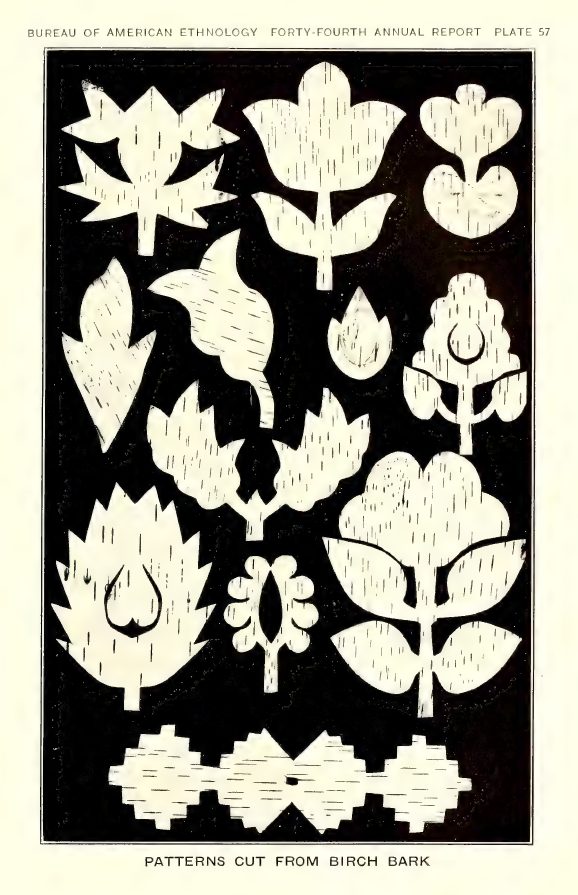
Bark was taken in June or early July with a simple ceremony and tobacco in the ground. Densmore watched Mrs. Razer fell a birch. Sheets were tied in packs of a hundred with fresh basswood strips. Heavy bark, six to nine layers thick, made canoes. The thinnest wrapped small packets like tissue. Makuks for sugar and berries, cones, dishes, cooking vessels, roof rolls, meat bags, fans, torches, cut figures and beadwork patterns.
IDEAS TO LEARN
Mrs. Razer habitually follows the old custom of placing tobacco in the ground when gathering any of the products of nature, so the old ceremony was performed in all sincerity.
page 150The heaviest bark, from large trees, comprises six to nine distinct layers and is so strong that it could be made into canoes carrying many persons.
page 151Birch bark can be unrolled only by exposing it to the heat of a fire. When heated it becomes pliable, and retains any form in which it is placed when thus softened.
page 151It was said that when a woman was cutting birch bark she often ‘sharpened her knife’ by drawing it across her hair.
page 151
MACHINE-READ TEXT · 35 PARAGRAPHS
Uncorrected OCR from the Smithsonian scan. Spelling of Ojibwe words and botanical names may be garbled. The scan is the record.
22 · pages 153–172
Transparencies, bitten patterns and etched bark
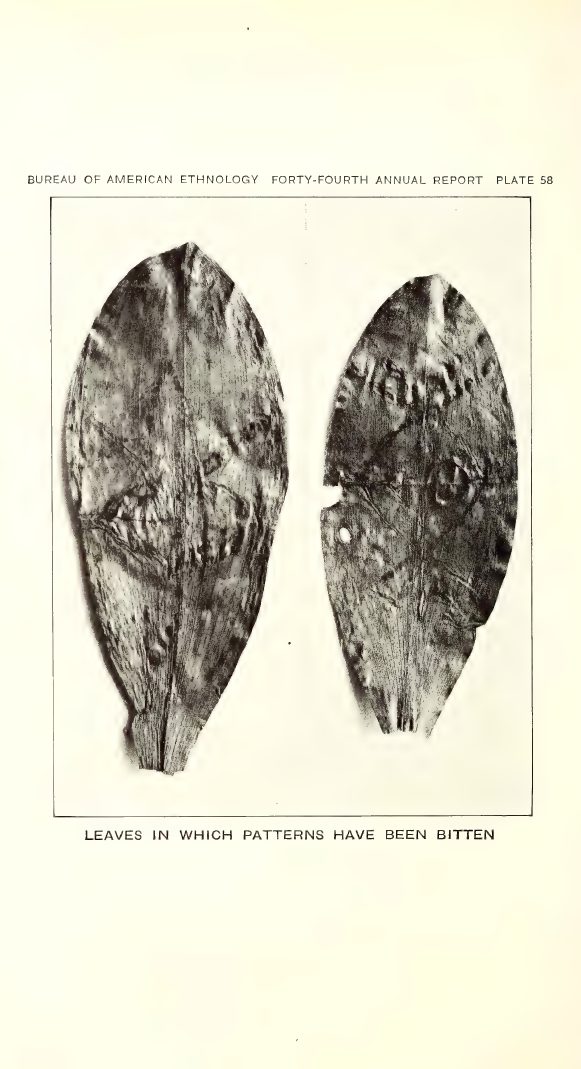
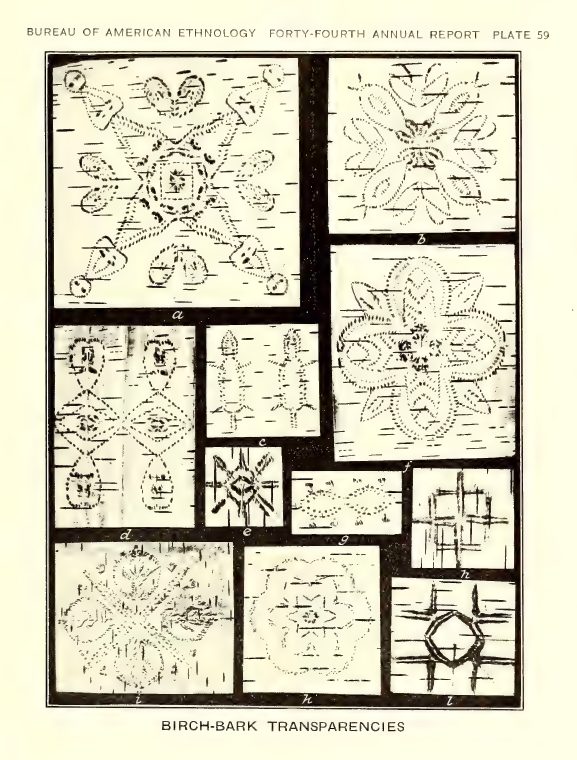
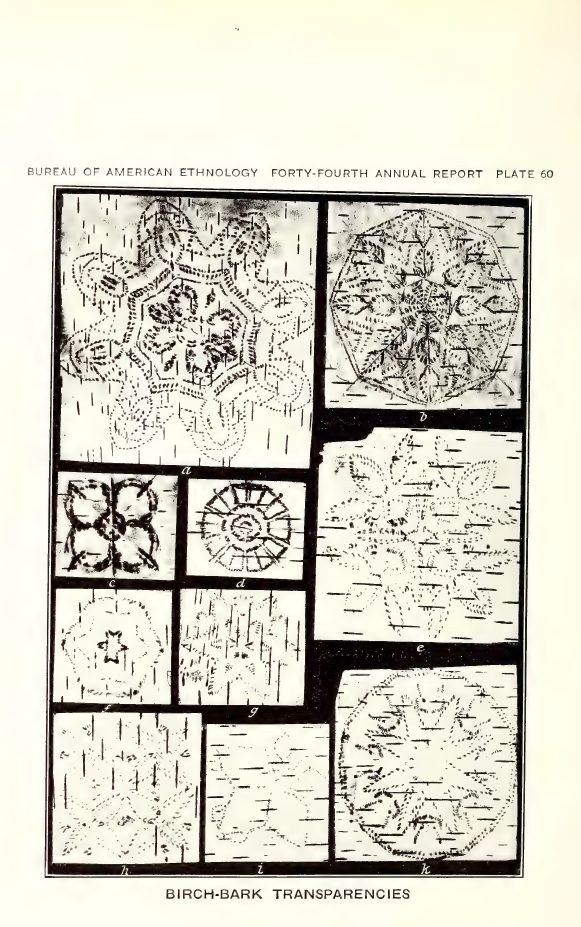
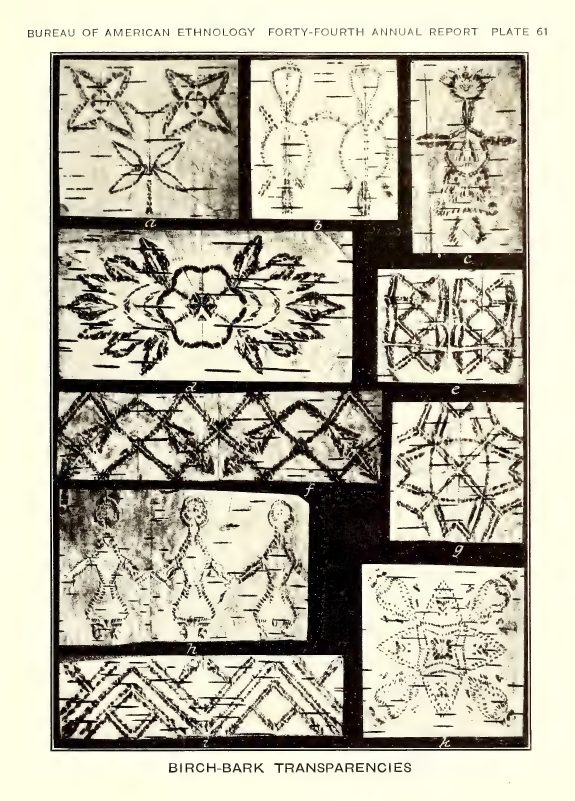
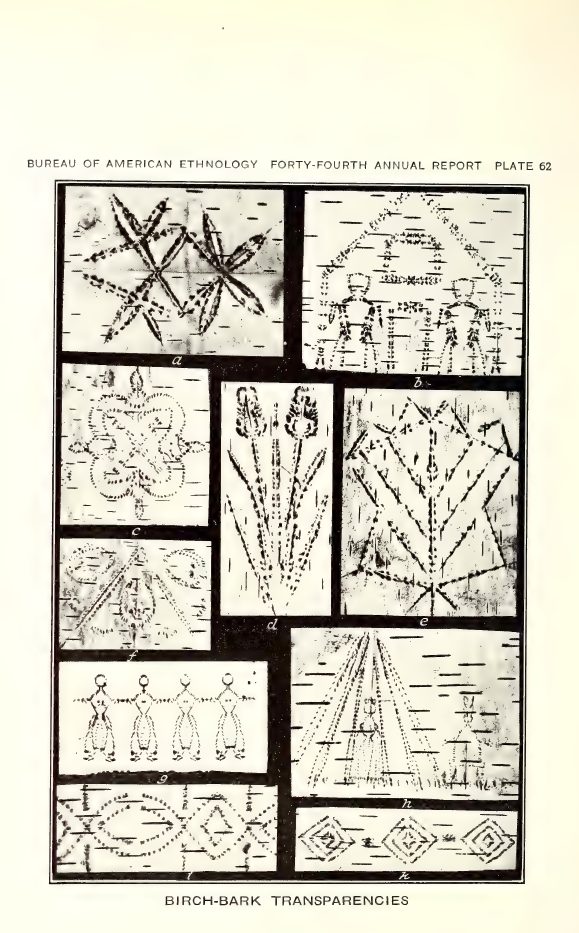
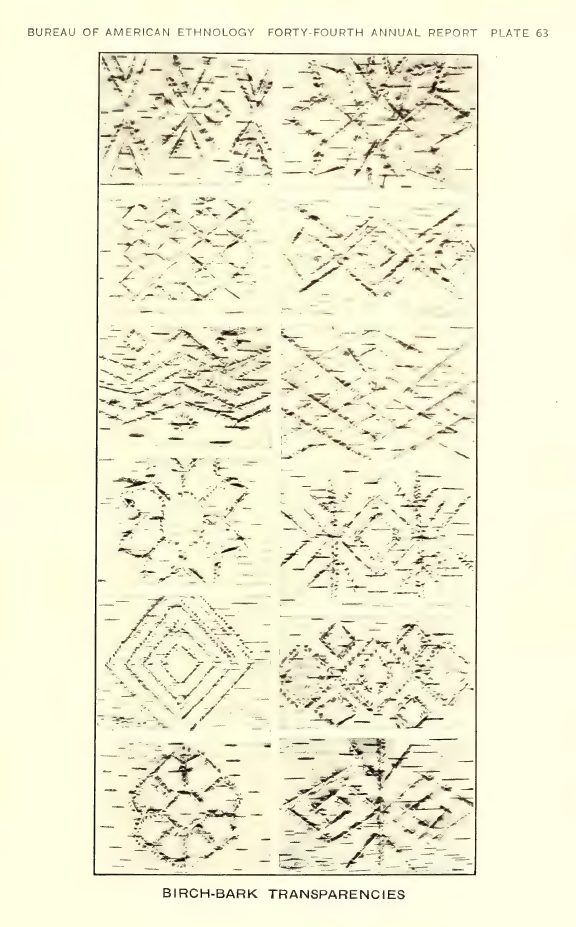
The most primitive form of Chippewa art: a leaf or a thin sheet of birch bark, folded and indented with the eyeteeth, unfolded and held up to the light. A winter-evening pastime in the wigwam and the sugar camp, and a source of beadwork patterns. Densmore collected more than two hundred from older women at White Earth, Red Lake and Manitou Rapids. The chapter closes with a story about a wife who bit bark instead of gathering it, and with etched and self-patterned bark taken in early spring.
IDEAS TO LEARN
The most primitive form of Chippewa art is that in which the only material is a broad leaf or thin piece of birch bark and the only tools are human teeth and deft fingers.
page 153It formed a pastime of the winter evenings, when the young people were seated in the wigwam with no other light than the fire, and it was especially practiced during the sugar camp.
page 160The patterns here illustrated were selected from a collection of more than 200, obtained from the older women at White Earth and Red Lake in Minnesota, and the Manitou Rapids Reserve in Canada.
page 170
MACHINE-READ TEXT · 34 PARAGRAPHS
Uncorrected OCR from the Smithsonian scan. Spelling of Ojibwe words and botanical names may be garbled. The scan is the record.